


Product Details
-
Cast iron platform/flat plate series
-
Machine Tool Casting Series
-
3D Flexible Welding Platform Series
-
Granite and Marble Series
-
Ground rail groove rail series
-
Cast iron bending plate series
-
Square Box and Square Tube Series
-
Machine tool pad iron series
-
V-shaped frame series
-
Square ruler series
-
Skewner series
-
Magnesium aluminum alloy series
-
3D Platform Fixture Series
-
Ring gauge series
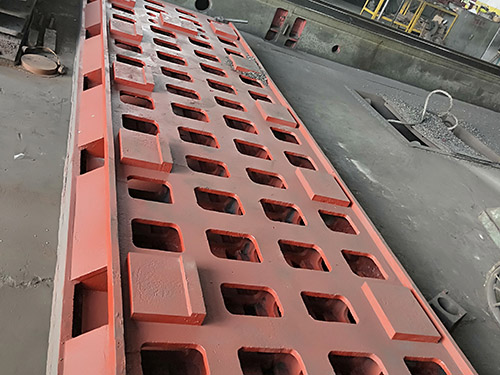
Large scale castings for machine tools
Large castings for machine tools:
1. Machine tool bed body casting: resin sand and lost foam casting are used to make the casting size uniform and consistent, without box fastening, and without burrs or flying edges; The surface smoothness is close to that of casting, the internal structure is stable, and casting defects such as sand holes and voids are eliminated or reduced.
2. Material: Cast iron HT250-300, with a long service life.
3. Annealing treatment: The casting undergoes two artificial aging treatments to remove internal stress. The internal structure of the casting is stable and not easily deformed.
4. Large scale machine tool castings can be assembled and produced separately during casting. Make overall modifications to improve installation and usage accuracy.
5. Characteristics: Good shock absorption: Graphite in cast iron is beneficial for lubrication and oil storage. Similarly, due to the superior shock absorption properties of graphite compared to steel; Good process performance: Due to its high carbon content and close eutectic composition, gray cast iron has a relatively low melting point, good flowability, and low shrinkage rate, making it suitable for casting complex or thin-walled castings. In addition, due to the ease of chip formation during cutting caused by graphite, the machinability of gray cast iron is superior to that of steel.
Large castings of machine tools include: gantry milling machine bed castings, vertical lathe bed castings, hydraulic machine body castings, horizontal lathe bed castings, and so on.
Advantages of large castings for machine tools:
1. Resin sand molds have good rigidity, and in the early stage of casting, it is possible to utilize the graphite expansion, shrinkage, and porosity defects during the solidification process of cast iron to achieve low riser and no riser casting of gray cast iron and ductile iron parts.
2. In the production of solid casting, polystyrene foam molding is used, and the self hardening sand molding with rosin resin is applied. When the metal liquid is poured into the mold, the foam plastic pattern will vaporize under the action of high diffuse metal liquid, burn and dissipate. The metal liquid will replace the position occupied by the original foam plastic, and will be cooled and solidified into a full mold casting with the same shape as the pattern.
3. Relatively speaking, lost foam casting has great advantages over traditional sand molds for producing single or small batches of automotive coverings, machine tool beds, and other large molds. It not only saves expensive wood mold costs, but also is easy to operate, shortens production cycles, improves production efficiency, has advantages such as size, small machining allowance, and good surface quality.
浙江Large scale castings for machine tools 广东Large scale castings for machine tools Recommended News
-
Core difference between ductile iron platform and ordinary cast iron platform (gray iron platform)
2026-05-26 10:14:51
-
How to judge the quality of cast iron parts? Teach you a few practical skills
2026-05-08 09:37:25
-
Why can't mechanical processing of cast iron platforms replace manual scraping and grinding for a lon
2026-04-22 02:32:46
-
Craftsmanship casting precision, Fengquan shines in Yongcheng - Hebei Fengquan Machinery shines at th
2026-03-26 01:49:33
-
The difference between HT-250 and HT-300
2026-03-11 09:42:53
CONTACT
—— Hotline:15733755098
—— Email:826899931@qq.com
—— Whatsapp:0317-8335666
—— Address:Xinhua Street, Jiaohe Town, Botou City